Shiv Jayanti at MKSSS
Total Views |


“Let Us Emulate Shivaji Maharaj, Who Never Compromised on Women’s Dignity!” – Mandar Paralikar
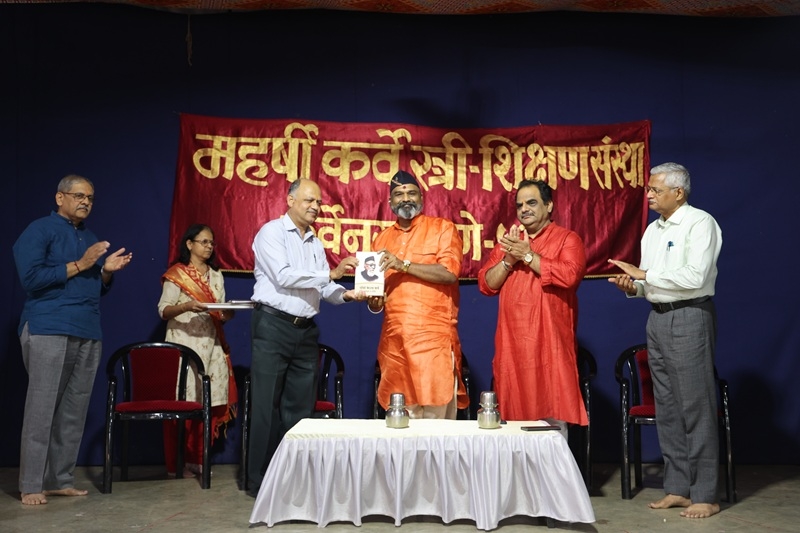
19 February – The 396th birth anniversary of Chhatrapati Shivaji Maharaj was celebrated with great enthusiasm at MKSSS. A large number of students, staff members, and office-bearers of the institution were present on the occasion. Shiv Charitra Scholar and Renown folk artist Shri.Mandar Paralikar attended as the chief speaker. The special lecture was organized at the Ichalkaranji Hall in the main campus of the institution. On the dais were Vice-Chairman Dr. Anand Lele, Management Committee member CA Abhay Kulkarni, Shri. Satyajit Chitale, and Secretary Dr. P. V. S. Shastry.
The program began with an aarti (devotional hymn) dedicated to Chhatrapati Shivaji Maharaj, composed by Veer Savarkar and sung by the staff of the head office. This was followed by the formal welcome of the speaker.
Highlights from the Chief Address
In his keynote speech, Shri. Mandar Paralikar began by praising the strength and contribution of the women of the institution. He said that although Chhatrapati Shivaji Maharaj is revered as a deity, merely performing rituals in his honor is not enough to fulfill our responsibility. He first provided a historical overview of the pre-Shivaji era.
He stated that India had faced many invasions, but the Muslim invasions were distinct because they were attacks on culture itself. He cited examples such as the brutal killing of Harpaldev of Devagiri and the towers of severed Hindu heads allegedly constructed under Aurangzeb. Although Shivaji’s father, Shahaji Raje, who had earned the title of “Raje” from Adilshah, was valiant, he could not establish Swarajya (self-rule) because the people were crushed under foreign domination. Against this backdrop, one must understand the dream of Swarajya shown to Shivaji by Jijau (Rajmata Jijabai).
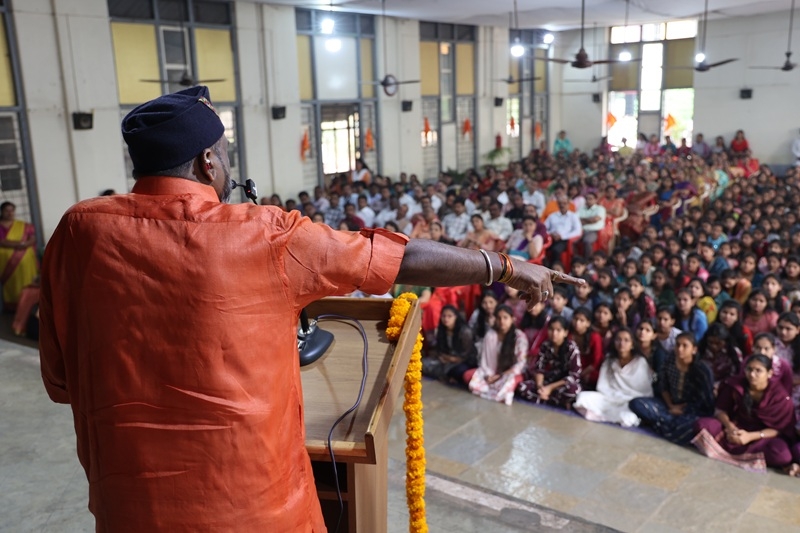
In his keynote speech, Shri. Mandar Paralikar began by praising the strength and contribution of the women of the institution. He said that although Chhatrapati Shivaji Maharaj is revered as a deity, merely performing rituals in his honor is not enough to fulfill our responsibility. He first provided a historical overview of the pre-Shivaji era.
He stated that India had faced many invasions, but the Muslim invasions were distinct because they were attacks on culture itself. He cited examples such as the brutal killing of Harpaldev of Devagiri and the towers of severed Hindu heads allegedly constructed under Aurangzeb. Although Shivaji’s father, Shahaji Raje, who had earned the title of “Raje” from Adilshah, was valiant, he could not establish Swarajya (self-rule) because the people were crushed under foreign domination. Against this backdrop, one must understand the dream of Swarajya shown to Shivaji by Jijau (Rajmata Jijabai).
He further explained that Murar Jagdev, a general of Adilshah, had devastated Pune so thoroughly that people were afraid even to reside there. Yet Jijau arrived in the ruined city with eight-year-old Shivba (young Shivaji) and symbolically ploughed the land with a golden plough, signaling reconstruction and hope. At the age of fourteen, Shivaji delivered his first judgment in Pune to protect a woman’s dignity — ordering the severing of the limbs of the oppressive Babaji Patil. Such a duty-bound and principled ruler, he said, must always remain in our remembrance.
By establishing a powerful navy, Shivaji Maharaj eradicated the inhuman trafficking of women conducted across the seas. Bringing Netaji Palkar, who had converted to Islam, back into the Hindu fold was described as a true social revolution. Shivaji Maharaj had personally witnessed the harm caused to society by false notions of caste superiority. Therefore, he united capable individuals from all castes with affection and built a vibrant organization. The upliftment of the “self” (Swa) was his life’s mission.
In 1674, at the time of his coronation, he intentionally replaced the then-prevailing Persian administrative language by creating the “Rajyavyavahar Kosh” and promoting Marathi in state affairs.
Concluding Appeal
He expressed regret that, due to political interests, efforts are being made to downplay Shivaji Maharaj’s inherent religiosity by presenting him merely in a secular framework, thereby diminishing his significance. He urged everyone to understand and counter such attempts. On the occasion of Shiv Jayanti, he appealed to all to take up at least one resolution — whether it be studying history, spreading historical awareness, or consciously embracing one’s mother tongue.
The program was compered by Smt.Nisha Shidhaye, Director of the Institute of Acutherapy. It concluded melodiously with a Shiv Stavan (hymn in praise of Shivaji) composed by Samarth Ramdas and sung by Kumari Abhijna Kulkarni of Vision English School.
By establishing a powerful navy, Shivaji Maharaj eradicated the inhuman trafficking of women conducted across the seas. Bringing Netaji Palkar, who had converted to Islam, back into the Hindu fold was described as a true social revolution. Shivaji Maharaj had personally witnessed the harm caused to society by false notions of caste superiority. Therefore, he united capable individuals from all castes with affection and built a vibrant organization. The upliftment of the “self” (Swa) was his life’s mission.
In 1674, at the time of his coronation, he intentionally replaced the then-prevailing Persian administrative language by creating the “Rajyavyavahar Kosh” and promoting Marathi in state affairs.
Concluding Appeal
He expressed regret that, due to political interests, efforts are being made to downplay Shivaji Maharaj’s inherent religiosity by presenting him merely in a secular framework, thereby diminishing his significance. He urged everyone to understand and counter such attempts. On the occasion of Shiv Jayanti, he appealed to all to take up at least one resolution — whether it be studying history, spreading historical awareness, or consciously embracing one’s mother tongue.
The program was compered by Smt.Nisha Shidhaye, Director of the Institute of Acutherapy. It concluded melodiously with a Shiv Stavan (hymn in praise of Shivaji) composed by Samarth Ramdas and sung by Kumari Abhijna Kulkarni of Vision English School.